Latest Research
New Research
The Thermoeconomics of Computation
All computational work exists on a continuous spectrum bounded by pure entropy production (randomness) and pure free energy extraction (intelligence). This framework treats energy (kW) as the fundamental constraint and medium of exchange — operators face a strict opportunity cost between routing power to cryptographic consensus or AI inference, and the resulting global equilibrium forms a closed thermodynamic loop where energy secures the ledger and intelligence optimizes future energy extraction.
Kilowatt Opportunity Cost
Proof of Work
Expected Free Energy
Logistics Function
Arbitrage
Landauer Limit
The Monetary Floor
Pmin = VConsensus(S(ER)) — the market capitalizes the thermodynamic sacrifice of Proof-of-Work into the value of the monetary unit, creating a liquid claim on future energy.
The Organizational Ceiling
Pmax is bounded by the Landauer limit and by the total free energy that resulting intelligence can marshal — V(I) follows a logistic curve between the randomness floor and the intelligence ceiling.
The Closed Loop
Kilowatts routed to ER secure the ledger that prices energy; kilowatts routed to EI generate intelligence that drives down the cost of the next kilowatt — a self-sustaining thermoeconomic loop.
From Big Bang to Blockchain
Two conversations exploring the deep arc from physics to proof of work — with DrK and Jordan Hall. How does the universe's thermodynamic arrow connect to the emergence of digital economic systems? These dialogues trace the thread from cosmological entropy production through biological computation to blockchain consensus.
Thermodynamics
Emergence
Consensus
Entropy
Cosmology
Part 1
Part 2
A Thermoeconomic Operator
All Proof-of-Work protocols anchor to the same physical phenomenon: repeated hash-based Bernoulli trials whose outcomes are IID. This paper connects the IID process to the Maximum Entropy Principle (Jaynes, 1957) and to the Generalized Boltzmann Distribution — the only distribution where Gibbs-Shannon entropy equals thermodynamic entropy. The blockchain is treated not as a ledger, but as a Thermoeconomic Operator: a system that converts physical work into informational order, creating a deterministic mapping between the physical and digital economic worlds.
Maximum Entropy
Boltzmann Distribution
SHA-256
PoEM Consensus
Qi Emission
Formal Isomorphism
Free Energy
Information as Rank
Threshold methods are lossy compression — they discard surplus entropy reduction. PoEM ranks outputs by absolute value, extracting maximum information from the state space and hitting the physical limit of finality.
Market-Induced Hamiltonian
The Hamiltonian is the price of the token. The market retroactively imposes an energy function on hash space, establishing a formal isomorphism — not physical identity — between hash-market systems and thermodynamics.
Information as Value
Qi emission is strictly proportional to hash rate (Watts). Because cumulative entropy reduction is a lossless proxy for work, Qi becomes a direct representation of the free energy supplied to the system — a unit of account for computational work.
Qi Quai - Controller Report
Can Active Inference or thermodynamics offer insight into the relationship between Qi and Quai? This report investigates the Quai Network's dual currency system through the lens of energy, entropy, and free energy — mapping the protocol's control mechanism, analyzing miner incentives, and building a conceptual bridge between cryptocurrency economics and the Free Energy Principle.
Active Inference
Dual Currency
Free Energy Principle
Proof of Work
Game Theory
Gresham's Law
Protocol Analysis
The kQuai controller balances demand by increasing kQuai when miners prefer Qi and decreasing it when they prefer Quai. Distilled to kQuai(i) = kQuai(i−1)[1 ± r].
Economics of Maintenance
Bitcoin's mining cost to market cap ratio (~1% annually) reveals undervaluation signals — a metric extensible to dual currency systems.
Thermodynamic Bridge
Qi maps to belief in the system (energy); Quai maps to belief in belief in the system (entropy). The equation is interpreted as a dialogue between P(x,y) and Q(x).
From Ontology to Computation: A Structural Framework
A concise roadmap connecting physical reality to computational work. Argues that ontology, mathematics, epistemology, and computation form a sequential dependency chain — bounded by thermodynamic laws and grounded in the insight that information is physical. Computation is framed as a competition for free energy to produce structured intelligence.
Ontology
Thermodynamics
Shannon Entropy
Landauer's Principle
Information Theory
Computation
Core Thesis
Reality → Mathematics → Epistemology → Computation is a linear structural progression, not a set of parallel disciplines. Each layer depends on the one before it.
Landauer's Bound
Erasing one bit of information requires at minimum E ≥ k_B T ln 2 of thermodynamic work — establishing an irreducible energy cost for all computation.
Thermodynamic Spectrum
All computational work spans a spectrum from pure entropy production (heat, randomness) to the extraction of free energy for structured, intelligent action on the physical world.
Engineering with Irreducibility
An integrative framework for emergence, tracing a path from Wolfram's computation to Deacon's teleodynamics to Nakamoto's proof-of-work. Treating all processes as computation is an epistemological choice with ontological consequences; computational irreducibility becomes the boundary condition that makes emergence possible. Proof-of-work is then read as the first engineering schematic for building symbolic value on top of a physically enforced constraint.
Emergence
Teleodynamics
Via Negativa
Symbolic Value
Constraint
Proof of Work
Emergence by Absence
Emergence is defined by boundary conditions, not by the thing itself — so it is best specified via negativa, by the constraints describing what it is not, rather than by any property embedded in the generating rule.
Three Levels of Cause
Deacon's hierarchy — thermodynamic, morphodynamic, teleodynamic — each strictly dependent on the layer beneath it. Proof-of-work spans all three: physical cost, cheap validation, and end-directed value.
Irreducibility as a Tool
Computational irreducibility is not only a limit on what observers can know — it is a mechanism engineers can deliberately impose to establish boundary conditions and cultivate emergent behavior.
Quantifying Work, Eliminating Time, and Minimizing Entropy
Consensus has always been a clock problem: Bitcoin bound time to state in the timechain, and every scaling effort since has been an attempt to loosen that coupling. This paper argues for replacing the clock entirely with causal invariance — ordering events by their intrinsic relationships rather than by timestamps — and pairs it with a dual-token architecture that separates store of value from unit of account, tokenizing cost of production directly in energy.
Causal Invariance
Entropy Minimization
Multiway Hypergraphs
Dual Token
Gresham's Law
Energy-Backed Money
Time as a Bottleneck
Traditional chains embed time in state updates, so throughput stalls until nodes agree on each block. Proof of History separates the two; causal invariance removes the need for a clock at all.
Trust as Entropy Reduction
To trust is to prune the space of adverse outcomes. Cryptographic primitives collapse "this could have come from anyone" into a single verifiable state — institutionalizing trust without a central actor.
Energy as Numeraire
Gold rewards stockpiling; energy rewards production. Denominating returns in the one input every industry requires aligns capital allocation with the driver of economic expansion itself.
Economic Observer Theory
The long-form treatment of natural emergence, running from the computational observer through the Principle of Computational Equivalence to the origins of symbolic value. If observers are computationally bounded and equivalent to the systems they observe, then price, temperature, and pressure are all the same kind of object — reductions an end-directed observer extracts from an irreducible world in order to spend less work.
Observer Theory
Computational Equivalence
Second Law of Statistical Mechanics
Emergence
Symbolic Value
Ruliology
The Bounded Observer
Observers are computationally equivalent to what they observe, and therefore find it irreducible. The second law is downstream of computational equivalence, not the other way around.
Reduction as Economics
End-directedness drives observers to equivalence states together and extract reducible insight — temperature, pressure, price. Any technology that increases that capacity will be exploited.
Value from Constraint
Symbolic value is defined not by substrate but by the features left absent by overlapping constraints — an empty container whose worth is set by the end-directedness of whoever uses it.
The Wolfram Model
A guided walk from A New Kind of Science to the Wolfram Model and the Ruliad. Starting with elementary cellular automata and their four behavioral classes, the essay builds through the Principle of Computational Equivalence and computational irreducibility into hypergraph rewriting — showing how space, time, relativity, and quantum branching emerge not as fundamental laws but as artifacts of how a finite observer samples the Ruliad. Closes with an even-handed account of how the program has been received, and where its credibility will ultimately be decided.
Cellular Automata
Computational Equivalence
Irreducibility
The Ruliad
Observer Theory
Causal Invariance
Ruliology
Physics from Observership
Statistical mechanics, general relativity, and quantum mechanics are derived bottom-up as consequences of a bounded observer being forced to sequentialize, coarse-grain, and consolidate the Ruliad — not as fundamental laws imposed on it.
Irreducibility as Leverage
Where computational reducibility compresses a system into a shorter description, multi-computation inverts the move — treating irreducibility as the resource, and navigation of the resulting landscape as an exercise in observer theory.
An Honest Ledger
The reception section states the case on both sides: concrete citable results and widely used tooling against self-publication outside peer review and a shortage of falsifiable predictions. The framework stands or falls on predictive power.
Core Ingredients of Blockchains: UTXO Handbook
An open-source visual reference to the Unspent Transaction Output accounting model and the design variations built on top of it across UTXO Alliance member chains. Flowcharts and plain-language explanation make the mechanics legible to builders, commercial partners, and non-technical readers — a presentation card for the full range of UTXO designs rather than a single implementation.
UTXO Model
eUTXO
Interoperability
Chain Design
Education
A Common Recipe
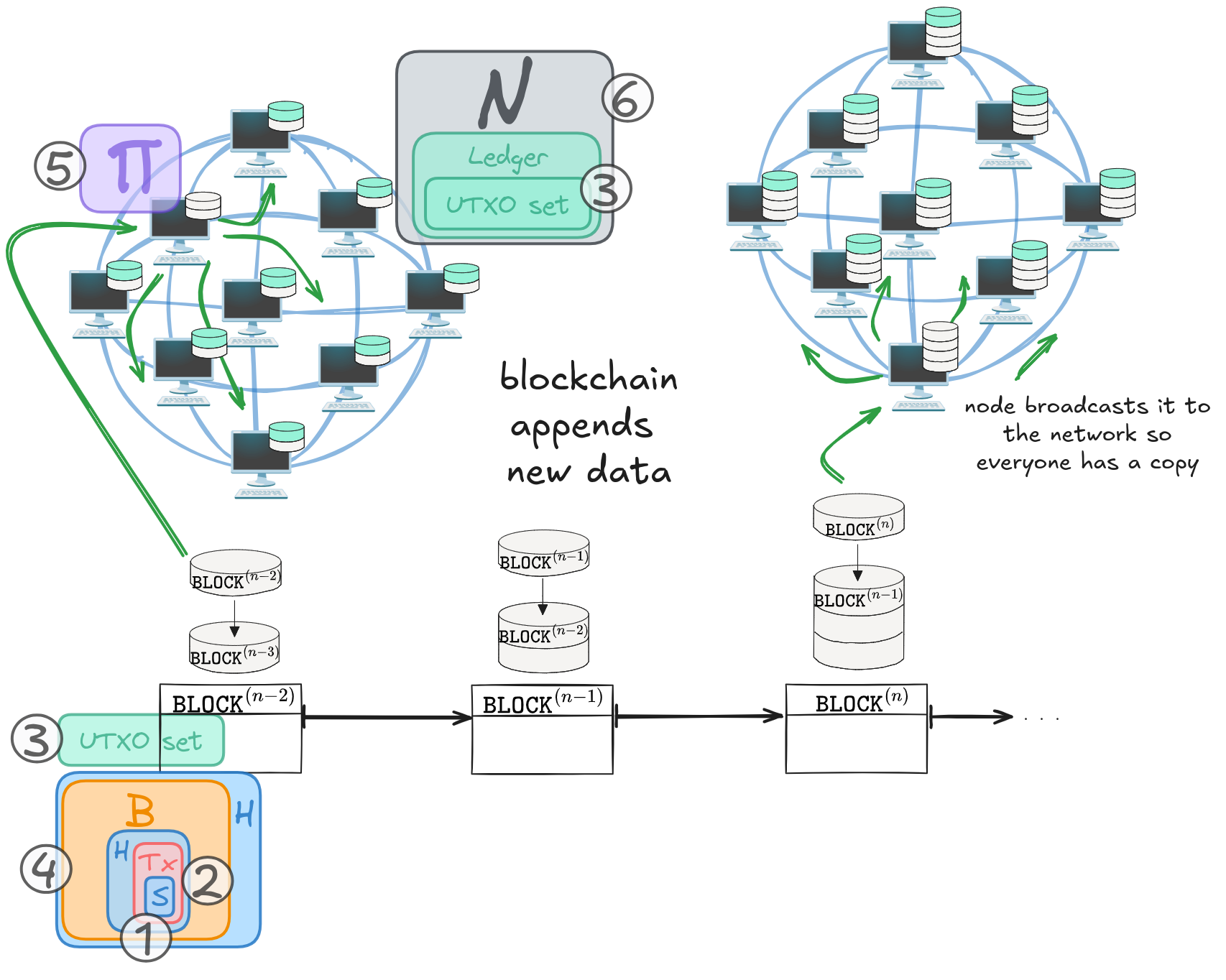
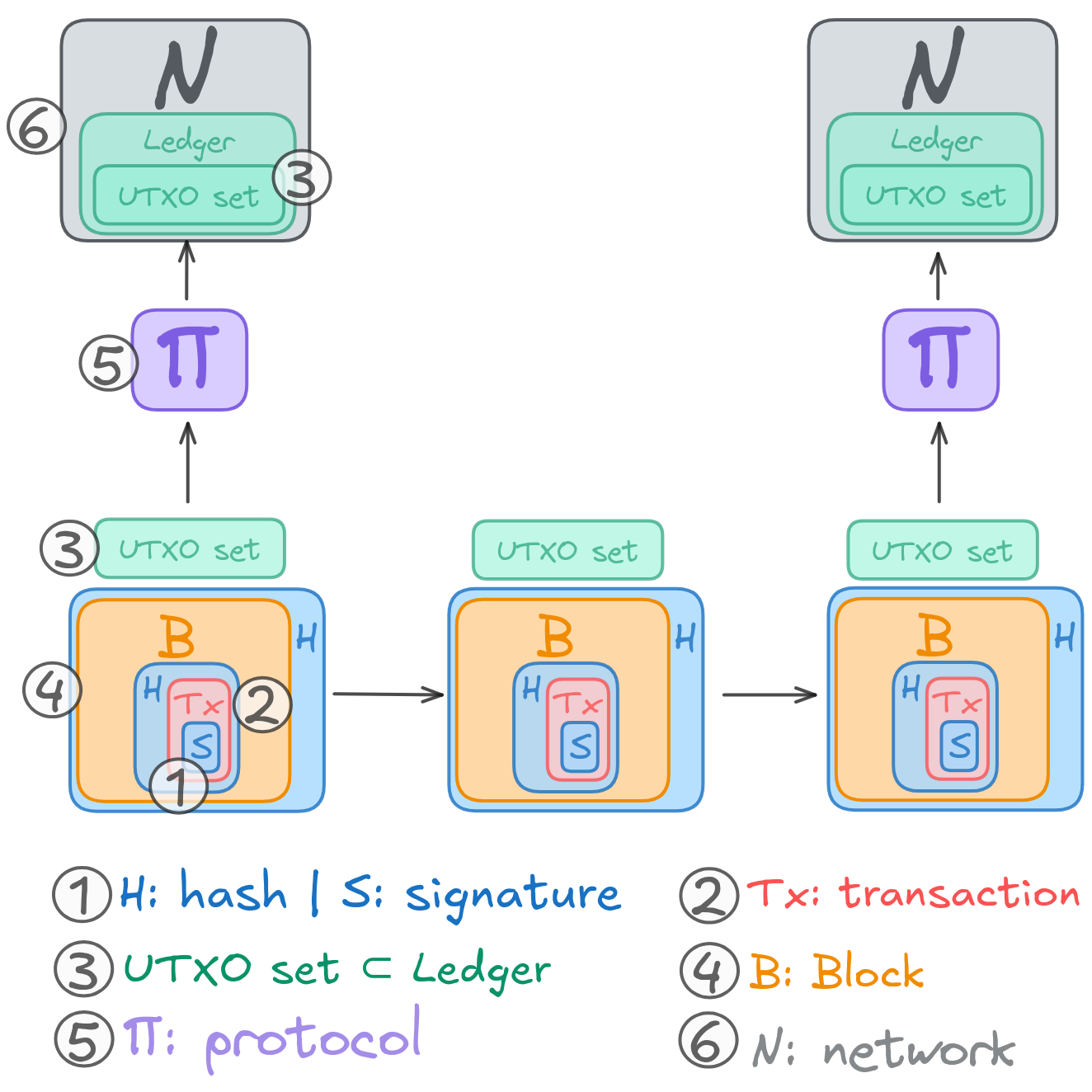
Every blockchain reduces to the same short list of ingredients — hash functions and signatures (H, S), transactions (Tx), the UTXO set and ledger, blocks (B), protocol (Π), and network (N). Design variety comes from how they are combined, not from what they are.
Flavors of UTXO
Nine member chains diagrammed side by side — Bitcoin's vanilla model, DigiByte, Cardano and Ergo's eUTXO, Nervos CKB, Quai Network, Topl, Alephium, and Hathor — exposing where each departs from the base design.
A Visual Language
Chapter 1 builds the ingredients as a consistent visual notation; Chapter 2 assembles them into working chains. Supplementary material contrasts the account model with UTXO for readers coming from Ethereum.
Crypto Protocols: Ergodicity & Consensus
A working tour of the four foundations a decentralized monetary system has to draw on — physics, information theory, distributed systems, and economics. Multiway hypergraphs supply the model of branching and merging; SHA-256 supplies the maximum-entropy state space; the leading-zero rule supplies the constraint that turns that space into hierarchical sequencing.
Ergodicity
Ensemble Averages
Multiway Hypergraph
SHA-256
Hierarchical Sequencing
Consensus
Watch the talk
Ensemble Averages
The same family of Poisson distributions plotted linear/linear, linear/log, log/linear, and log/log — a reminder that the scaling you choose decides which structure in the ensemble you are able to see at all.
Maximum Entropy Plus a Rule
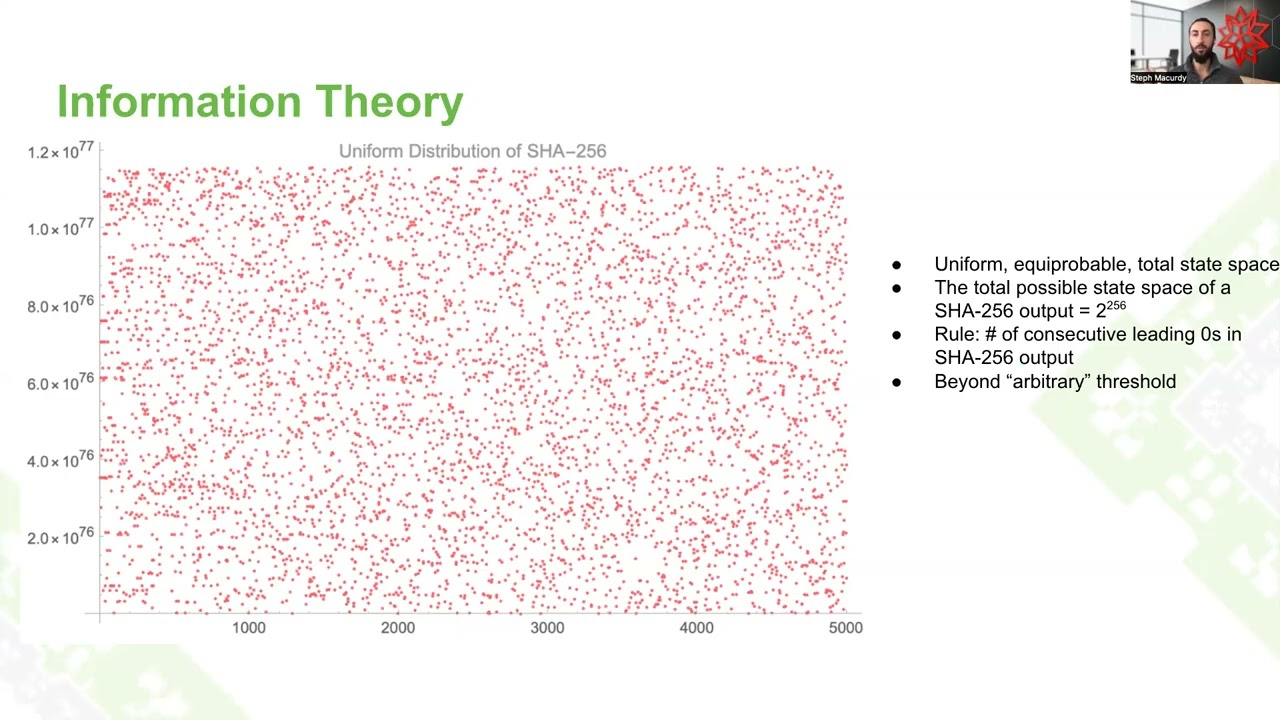
SHA-256 outputs are uniform and equiprobable across a 2256 state space. Counting consecutive leading zeros imposes a constraint on that space, and each zero is a bit of uncertainty removed.
Money & The Free Energy Principle
Two roads run from the same origin: an informational road through proof of work, distributed consensus, Shannon information, and the maximum entropy principle, and a physical road through gradient dissipation, least action, and self-organization. They meet at active inference — and the meeting point is where money gets its thermodynamic reading.
Free Energy Principle
Active Inference
Proof of Entropy Minima
Landauer's Bound
Causal Invariance
Dual Currency
A Difference That Makes a Difference
∆S = 2−n, where n is the number of states removed from the macrostate. The bit that longest-chain PoW forfeits is the bit PoEM keeps — the difference between instantaneous finalization and waiting out multiple rounds of validation.
Information is Physical
Landauer's bound, verified in the double-well Brownian experiment, prices erasure at kBT ln2. Computation is work, so a consensus rule that measures entropy reduction is measuring free energy expenditure directly.
Belief and Belief in Belief
Qi rewards track block difficulty (kQiB); Quai rewards move through the controller kQuai(i) = kQuai(i−1)[1 ± r]. Qi carries entropy and the unit of account, Quai carries free energy and the store of value.
What Does a Dollar Cost to Make?
Arithmetic is the same everywhere; monetary production is not. The talk starts from a question with a public answer — what a note costs to print — and follows it into seigniorage, monetary aggregates, and the case for a production function that anyone can audit and any machine can verify.
Seigniorage
Monetary Supply
Bitcoin Production Function
Commodified Compute
Randomness
Ontology
Seigniorage Actualized
Federal Reserve variable printing costs run 4.1 to 11.3 cents per note depending on denomination — putting realized seigniorage between $0.959 and $0.9999 on the dollar.
An Auditable Alternative
Set the M1, M2, and monetary base series against Bitcoin's production function — 32 halving epochs of 210,000 blocks at 50/2i — and the contrast is between a supply you observe after the fact and one you can compute in advance.
What Normalizes
Oil, solar, and nuclear watts are not fungible, and a watt here is not a watt there — but a FLOP here is approximately a FLOP there. Commodified compute plus definable randomness gives a unit that is permissionless, enforceable, and meritocratic.