A New Science Is Emerging

Thermoeconomics.

Where physics meets money. A computational framework connecting energy, entropy, and proof of work to the foundations of economic value.

By Steph Macurdy · Wolfram Blockchain Labs · UTXO Alliance

Science

What is thermoeconomics?

Thermoeconomics sits at the intersection of physics, information, computation, and economics. It treats economic value not as an abstraction, but as something grounded in physical reality — energy expended, entropy produced, work performed. The economy is a complex system where these dynamics align in blockchain consensus.

Entropy is the starting point. Shannon (1948) showed that information has a precise mathematical structure identical to thermodynamic entropy. Jaynes (1957) extended this into a universal inference engine: given limited information, maximize entropy.

Distributed computing establishes why consensus is hard. Lamport (1978) proved that without a global clock, logical ordering is the only coherent notion of time in a network. FLP (1985) showed that guaranteed consensus in an asynchronous system is impossible.

Energy grounds everything in physics. Landauer (1961) and Bennett (1973) established that computation has an irreducible thermodynamic cost — erasing a bit dissipates real heat, and even reversible computation cannot fully escape this floor.

Proof of Work is where theory becomes protocol. Nakamoto exploited cryptography to create trustless accounting — a system that converts physical work into a verifiable record of economic reality.

Entropy
Shannon showed information and thermodynamic entropy share the same equation. Jaynes used this to build a universal inference framework. Wolfram asks if the universe itself is a computation — and irreversibility its signature.
Distributed Computing
Lamport proved time in a network is logical, not physical. FLP showed guaranteed consensus is impossible — making probabilistic PoW the theoretically correct solution. Karpathy brings the problem forward into autonomous AI agent networks.
Energy
Landauer (1961) and Bennett (1973) established that computation has an irreducible thermodynamic cost — erasing a bit dissipates real heat, and even reversible computation cannot fully escape this floor.
Proof of Work
Nakamoto exploited cryptography to create trustless accounting — a system that converts physical work into a verifiable record of economic reality.

Latest Research

New work in thermoeconomics

Essay + Conversations January 2026
From Big Bang to Blockchain
Karl Kreder PhD, Jordan Hall, & Steph Macurdy
Two conversations exploring the deep arc from physics to proof of work — with DrK and Jordan Hall. How does the universe's thermodynamic arrow connect to the emergence of digital economic systems? These dialogues trace the thread from cosmological entropy production through biological computation to blockchain consensus.
Thermodynamics Emergence Consensus Entropy Cosmology
Part 1
Part 2
Paper December 2025 · 11 pages
A Thermoeconomic Operator
Steph Macurdy, Wolfram Research
All Proof-of-Work protocols anchor to the same physical phenomenon: repeated hash-based Bernoulli trials whose outcomes are IID. This paper connects the IID process to the Maximum Entropy Principle (Jaynes, 1957) and to the Generalized Boltzmann Distribution — the only distribution where Gibbs-Shannon entropy equals thermodynamic entropy. The blockchain is treated not as a ledger, but as a Thermoeconomic Operator: a system that converts physical work into informational order, creating a deterministic mapping between the physical and digital economic worlds.
Maximum Entropy Boltzmann Distribution SHA-256 PoEM Consensus Qi Emission Formal Isomorphism Free Energy
Information as Rank
Threshold methods are lossy compression — they discard surplus entropy reduction. PoEM ranks outputs by absolute value, extracting maximum information from the state space and hitting the physical limit of finality.
Market-Induced Hamiltonian
The Hamiltonian is the price of the token. The market retroactively imposes an energy function on hash space, establishing a formal isomorphism — not physical identity — between hash-market systems and thermodynamics.
Information as Value
Qi emission is strictly proportional to hash rate (Watts). Because cumulative entropy reduction is a lossless proxy for work, Qi becomes a direct representation of the free energy supplied to the system — a unit of account for computational work.
Report November 2025 · 24 pages
Qi Quai - Controller Report
Andrius Kulikauskas PhD, Math4Wisdom; Commissioned by Steph Macurdy
Can Active Inference or thermodynamics offer insight into the relationship between Qi and Quai? This report investigates the Quai Network's dual currency system through the lens of energy, entropy, and free energy — mapping the protocol's control mechanism, analyzing miner incentives, and building a conceptual bridge between cryptocurrency economics and the Free Energy Principle.
Active Inference Dual Currency Free Energy Principle Proof of Work Game Theory Gresham's Law
Protocol Analysis
The kQuai controller balances demand by increasing kQuai when miners prefer Qi and decreasing it when they prefer Quai. Distilled to kQuai(i) = kQuai(i−1)[1 ± r].
Economics of Maintenance
Bitcoin's mining cost to market cap ratio (~1% annually) reveals undervaluation signals — a metric extensible to dual currency systems.
Thermodynamic Bridge
Qi maps to belief in the system (energy); Quai maps to belief in belief in the system (entropy). The equation is interpreted as a dialogue between P(x,y) and Q(x).

The Curriculum

Learn by computing

Five modules take you from blockchain fundamentals through cryptography to the thermoeconomic thesis. Every concept comes with runnable code.

Primary track: Wolfram Language on Wolfram U · Open-source track: Python in the Study

Start on Wolfram U → Free course · Wolfram Language · Interactive notebooks

Blockchain Architectures

UTXO Ledger Model

From Bitcoin's original design to the exotic variants powering modern chains — the UTXO Alliance maps the entire landscape.
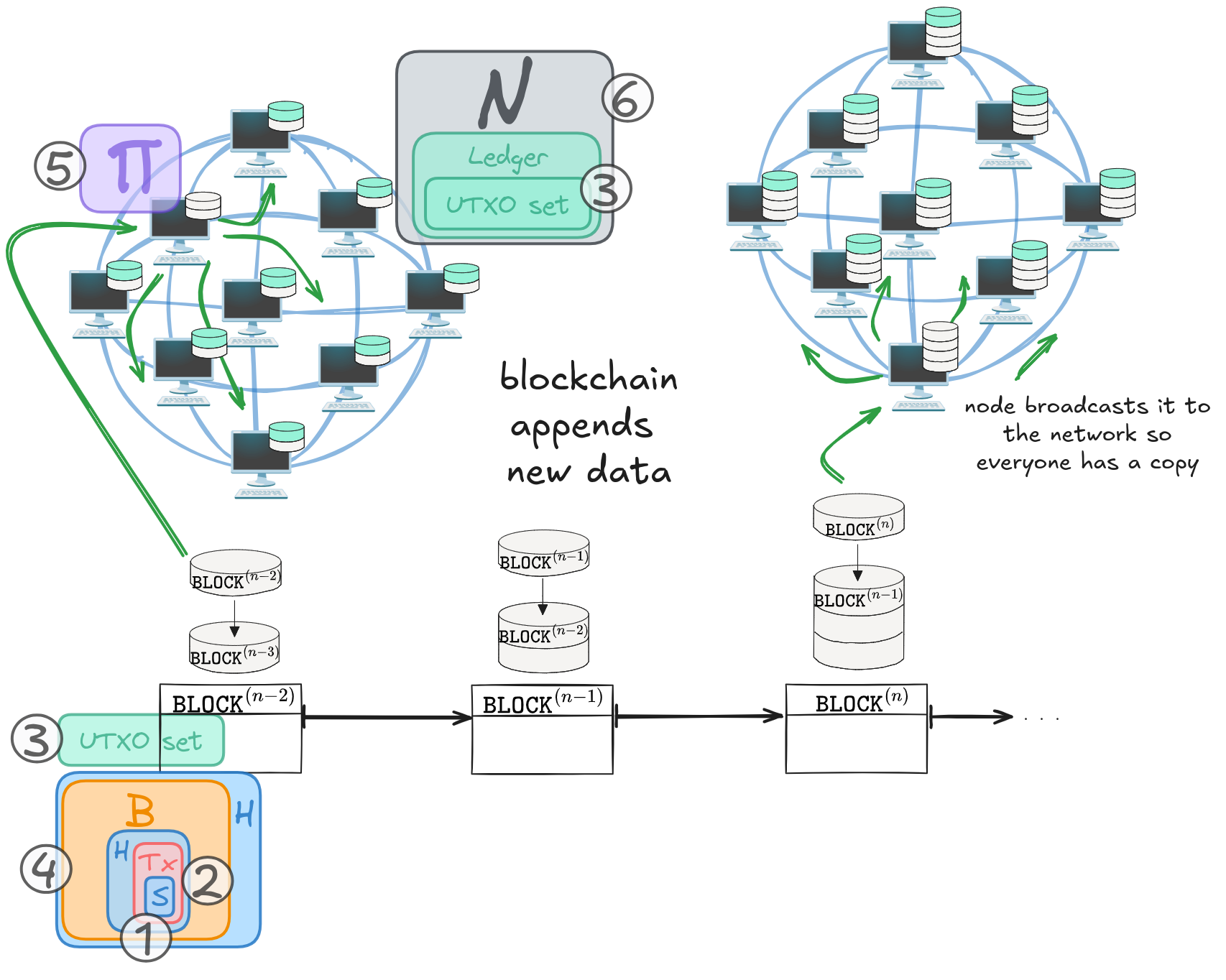
High-level blockchain architecture — UTXO Alliance Handbook
High-level blockchain architecture — how transactions flow from creation to consensus
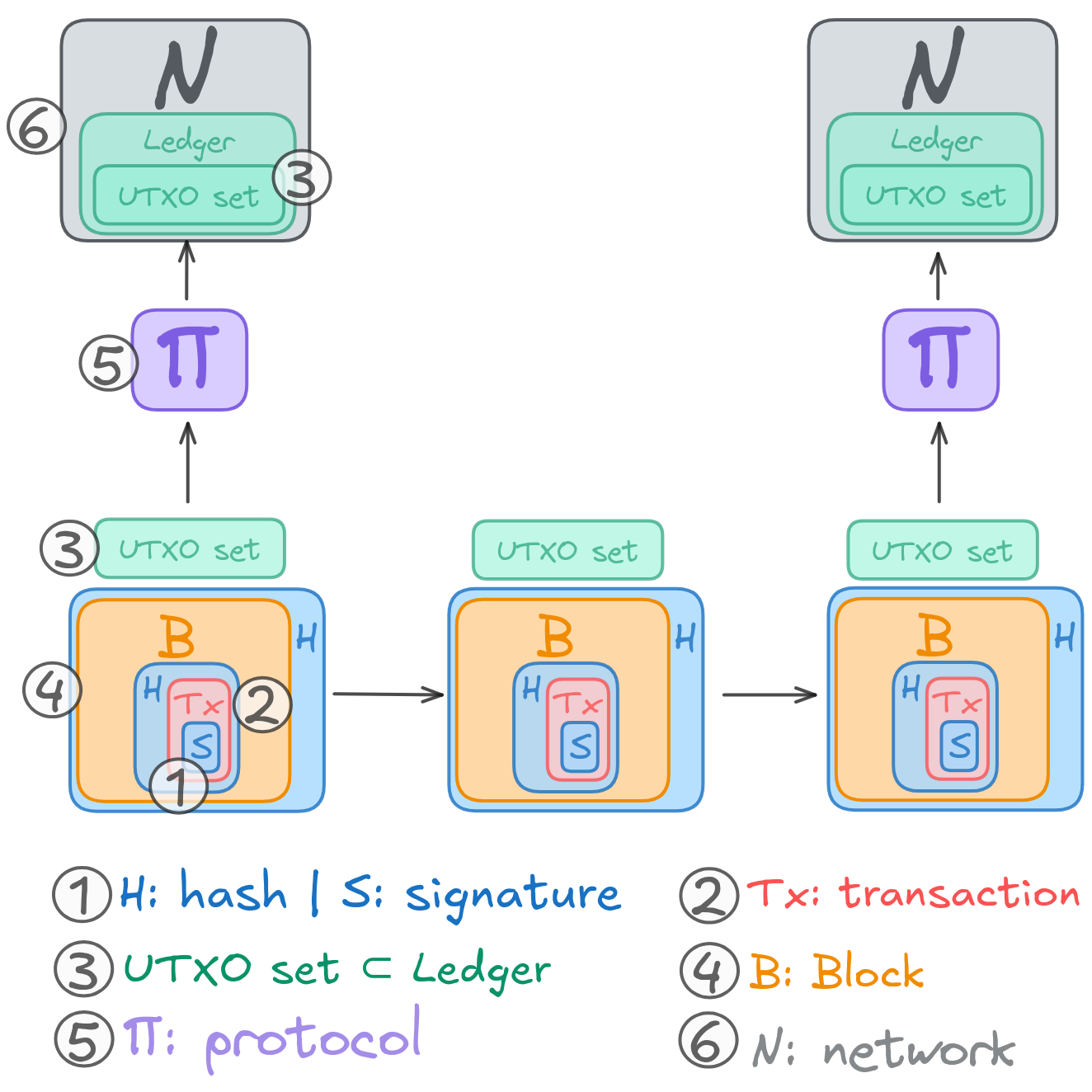
Simple blockchain structure — UTXO Alliance Handbook
The building blocks — transactions, blocks, and the chain that connects them

Bitcoin introduced the Unspent Transaction Output (UTXO) model — a fundamentally different way of tracking value on a blockchain. Instead of accounts with balances, the system tracks individual outputs waiting to be spent.

Since Bitcoin, dozens of chains have taken this foundation and built on it — adding smart contracts, sharding, merged mining, and more. The UTXO Alliance brings these projects together to advance the model. The knowledge base includes a comprehensive visual guide to every major UTXO variant, adapted from the Alliance's official handbook.

Explore in the Study →
Bitcoin Cardano Ergo Nervos Alephium Quai Network DigiByte Hathor
Diagram from the UTXO Alliance Handbook

Interactive Tools

Compute, explore, verify